Thursday, 4 July 2013

Flashback: Passions Run Deep in Mystic River


The river has many depths. Let it wash over you.
Mystic River, a film of many depths, tells the story of three men, friends since childhood, who are reunited in tragedy. Tragedy overshadows their lives in many forms, across many generations; the loss of a daughter, of a childhood, and a wife. Based on the novel by the same name, the film was directed by Clint Eastwood, and stars Sean Penn, Tim Robbins, and Kevin Bacon. The film is a passionate, darkly intense, emotional drama with an heartfelt honesty filled with hope. With remarkably sincere performances, and beautiful on-location backgrounds of working-class Boston, Mystic River is a masterful portrait that is above all authentic. On top of receiving an Academy Awards nomination for best picture in 2003, both Sean Penn and Tim Robbins snagged the oscar for best leading role and supporting role for their breathtaking performances. 
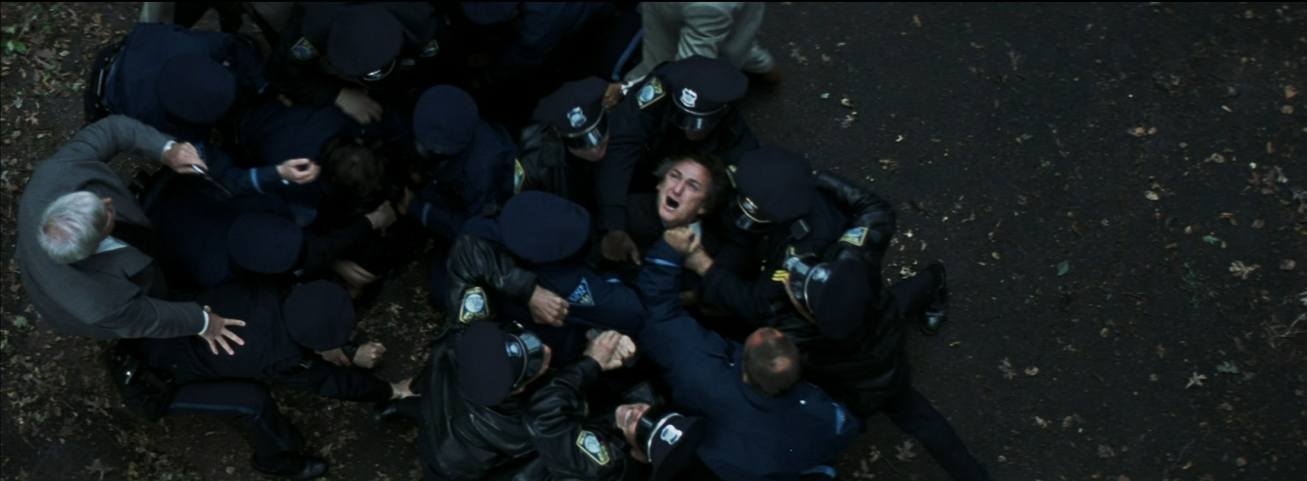

Movie Moment: Sean Penn and Tim Robbins both give incredible performances. And each of them had their own moment. 

Is that my daughter in there? Sean Penn's performance as Jimmy Markum, a man with a troubled past, is riveting. The"is that my daughter" scene, and I can bet many agree, is a defining moment of the film. His portrayal in the scene of a man who's just lost a daughter is unbelievably honest. And it's not only his performance that makes the scene. The camera work amplifies it. A sea of police men swarm him, the camera swoops upwards, portraying a birds eye view shot enhancing the powerless vulnerable state of Jimmy.

The last time I saw Dave, was 25 years ago, going up the street in the back of that car. Tim Robbins portrayal as Dave, a man abducted and sexually abused as a child, a man who lost a part of himself, is also painfully authentic. Several times, they cut back to the shot of the sidewalk, reminding us of the incident of the abduction, as if the moment is stuck there forever. The meaning in the shot is chilling. Only half of Dave's name is carved, as if a part of him was taken that day. It reminds us that a moment can change your life forever.


Tuesday, 2 July 2013

Room 237 Draws You Back Into Stanley Kubrick's Maze

Some movies stay with you forever...and ever...and ever. There is something profoundly remarkable about a film when it's over 30 years old and still has the ability to inspire speculation, debate, and continue to haunt us to this day. Room 237 is a documentary that explores the countless theories about the hidden meanings within Stanley Kubrick's 1980 film The Shining.


The documentary weaves together 5 different points of view through voice over, archive footage, film clips, animation, and reenactments. Different subjective theories are explored, including the holocaust, sexual (and incest) themes, the wipe out of the Native Americans, and the faking of the lunar landing, to name a few.

At the time of The Shining, Kubrick was fascinated with advertising and the idea of subliminal messaging. Many of the techniques found in advertisements, Kubrick implemented into the film. He became a master of subliminal messaging in cinema. Kubrick had an incredible eye for detail. Every detail is intentionally fixed into the film. Even the tiny minor details that seemingly slip past your conscience, have overflowing meaning. The Shining is like no other in this way and because of this, it continues to be analyzed and obsessed over to this day. Stanley Kubrick was a genius. A cinematic Einstein. Dissecting The Shining is like picking apart an Einstein equation. There are endless pieces to the equation. And as difficult it is to fathom, we know one thing; Every piece equals up to something.

In the end, what the film means is up to you, and everyone else. I think the most important aspect of the film is not objectively what it means but the power the film bestows upon us. The act of searching for themes, making profound connections, and exposing our minds to deeper meaning allows us to see reality through a higher level of awareness and enlightenment in our own lives.

Whether you are a Kubrick fan, a Shining fan, or just a fan of film in general, Room 237 will draw you into the twisting and winding maze of a brilliant movie and mind.


Wednesday, 26 June 2013

Brad Pitt Saves Humanity From Zombies and Movie Flops in WWZ

So how loyal did World War Z stay to it's novel counterpart?  Based on the non-fiction novel by Max Brooks, the book tells the story of the geopolitical, social, religious, and environmental impact resulted from the zombie war, from a wide variety of perspectives on a global context. The movie follows the story of Brad Pitt's character, Gerry Lane, a United Nations employee, who races against time to save humanity against the Zombie pandemic. I'm not going to lie, it was entertaining in the Hollywood-Big-Blockbuster way, but yet, I can't help imagining what they could have done to move away from a linear narrative path, and stick more closely to the documentary-nonfictional feel of the book.

With that said, adapting the book was not a simple task whatsoever, and I'm sure the idea has crossed the minds of many throughout the course of the project. In 2007, the project began when Brad Pitt's production company Plan B secured the rights to the film and an adapted screenplay was written by J. Michael Straczynski. In 2009, after many delays as the script was still "far from realization," the script was rewritten by Matthew Michael Carnahan. Filming began in July 2011, but several reshoots were scheduled in 2012 after writers Damon Lindelof and his Lost Partner Drew Goddard were hired to rewrite the film's third act. Several scenes were dropped and a new ending was built to make the film less "abrupt and incoherent" and to water down the film's political undertones and drive the film to a more "family summer blockbuster." 

With three different writers on board and credited, did this affect the overall consistency of the plot? I can say that the film did seem a little short, in my opinion, as it lacked the need for a larger and more definitive climax. I also would have liked to see more scenes on a global scale. It is called World War Z after all. Having said that, I can say that Brad Pitt saves it. And I'm not just saying that because you get to watch Brad Pitt's face in high definition for two hours. There's something about Brad Pitt that legitimizes a film, and it's apparent in any film he's part of. If anyone else was cast in the lead role; a Channing Tatum, even a Tom Cruise, this would be completely different film.


Now, just in case we ever find ourselves in the middle of a zombie apocalypse, here are some tips I gathered from the film:


How to Survive a Zombie Apocalypse Brad Pitt Style


1. Magazines make good armour.

2. Keep your finger off the trigger.

3. Nova Scotia is always the answer.

4. Aichmophobia? Get over it.

5. Know how to count.

6. Turn your phone on silent. 

7. Family is always first.

8. Always listen to the dog. No matter how annoying it is.

9. Piling things is a good barricade...chairs, suitcases, whatever!

10.  It's the Zombie Apocalypse, but dammit never forget to accessorize.


What did you think of World War Z? 

Wednesday, 19 June 2013

New Trailer: Team Scorsese - Dicaprio's Wolf Of Wall Street


Martin Scorsese and Leonardo Dicaprio team up again in the crime drama The Wolf of Wall Street. The film, based on the autobiography by the same name, follows Jordan Belfort, a headstrong New York stockbroker (played by Dicaprio), who refuses to cooperate in a massive security fraud case involving widespread corruption on Wall Street, in the corporate banking world and mob infiltration. Drugs, sex, money, greed, power. This black satire looks fast-paced, filthy, and rather hilarious. A lobster get's thrown at someone, Dicaprio does a little jig, and Matthew McConaughey performs an off-the-cuff-chest-pound-hum thing (which supposedly was completely improvised). Not to mention, Jonah Hill is also in it. Certainly, it will be interesting to see the dynamics of a unique cast.

The film hits theatres later this year on November 15th.

Monday, 17 June 2013

Chasing Ice: Big Ideas Big Visuals

Chasing Ice, a documentary that follows National Geographic environmental photographer and adventurer James Balog takes us on a breathtaking journey across the Arctic as he deploys time-lapse cameras to capture multi-year records of the ever changing glaciers. Balog's videos, composed of thousands of still images, compress years into seconds as they capture ancient ranges of ice melting right before our eyes. 
James Balog was once a skeptic about climate change, even with his scientific upbringing. With one trip north, and the visual evidence before him, it sparked an idea within him: The Extreme Ice Survey. With a team of young adventurers, Balog sets out across the Arctic landscapes of Greenland, Iceland, and Alaska to plant time-lapse cameras to record the melting glaciers. According to Balog, visual evidence of our changing planet is what people need, more so than the facts or statistics. 

The images are incredibly stunning. They truly capture the power and history of these massive forces of nature. And at the same time, I could feel a sort of serene sadness watching them. Some of the shots are other-worldy. They evoke a simplicity, a beginning of time, and a human-nature relationship. It reminds us that we humans depend on nature as much as nature depends on us.

There is no doubt that the Arctic is changing. You can see it plain and clear in Balog's videos.  I believe that teaching the world through the visual is extremely valuable. In such a visually enriched world, there's a growing need to see to believe. But as much as visual evidence is important, we need the facts too. We see the change, but what exactly is changing it? And more importantly, how do we stop it from changing?

Watch the Official Trailer:
Learn more about the film here

Friday, 14 June 2013

A Tribute To Alfred Hitchcock

The Master of Suspense. A kind of suspense that he understood to be universal and eternal. He established techniques that are used to this day.

"Fear isn't so difficult to understand. After all, weren't we all frightened as children? Nothing has changed since Little Riding Hood faced the big bad wolf. What frightens us today is the exact sort of thing that frightened us yesterday. It's just a different wolf. This fright complex is rooted in every individual."
-Alfred Hitchcock

Sure, our wolf today may look a little different (maybe some more CGI, maybe some more gore) than the one from Alfred Hitchcock's time. But the fundamental aspect of the wolf, the feeling the wolf gives us, fear is universal. It's not the what we're scared of, it's how it's presented to us. Suspense is the how. It can make us fear anything. This is why his films are timeless.

Take a step down memory lane in this Alfred Hitchcock "Film Checklist" Tribute by Jean-Baptiste Lefournier:


Monday, 10 June 2013

Short Film: "Under The Knife" - Etta Bond


A short film collaboration project for the "Random Acts" series by Channel 4 literally goes "Under The Knife." The film, directed by Jeremy Cole, opens with a continuos shot of UK singer Etta Bond which is fragmented into hundreds of shattered pieces. 1374 3D layers in After Effects to be exact, all individually key framed and positioned. As the song progresses, the pieces begin to merge together, revealing a face behind the voice.

"Under The Knife" is undeniably unique and technically beautiful, with a powerful message. And not to mention, Jeremy Cole is an After Effects wizard.

See how the film was made here.